
UAV Conceptual Design Optimization
The NextPilot team provides conceptual design, aerodynamic shape optimization, flight performance evaluation and other overall design services, helping customers iterate quickly at the proposal stage and reduce design risk.
Integrated Delivery
Aerodynamic data and dynamics models can interface directly with the PX4 flight control virtual flight simulation, forming a complete loop from overall design to flight control verification, avoiding duplicate modeling and significantly shortening the development cycle.
Aerodynamic Database Computation and Analysis (CFD)
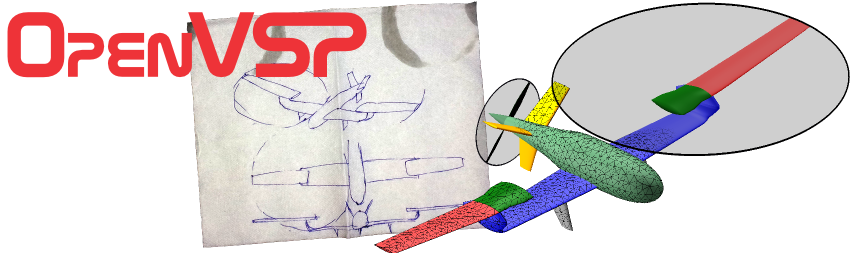
OpenVSP is a free, open-source 3D aircraft modeling software developed by NASA, supporting Windows, Linux and macOS.
OpenVSP uses parametric modeling, allowing users to define a 3D aircraft model through general engineering parameters and then process it into formats suitable for engineering analysis. OpenVSP has been widely adopted by industry, government and academia, covering UAVs, eVTOL, civil supersonic, hypersonic, space launch and small satellite domains.
- Aerodynamic database development: computes aerodynamic data across the full flight envelope using CFD, providing accurate aerodynamic coefficients (lift, drag, moment coefficients, etc.) for flight control system design.
- Aerodynamic shape optimization: leverages the fast iteration advantage of parametric modeling to optimize the aerodynamic shape of wings, tails, fuselage and other components, balancing aerodynamic efficiency with structural feasibility.
- Flow field visualization: provides pressure distribution, streamline plots, vorticity plots and other flow field visualizations to intuitively present aerodynamic characteristics and support design decisions.
- Multi-condition computation: covers typical conditions such as takeoff, cruise and landing, as well as special flight states such as crosswind and high angle of attack.
Flight Performance Evaluation and Stability & Control Analysis
Based on the aerodynamic database obtained from CFD, we perform comprehensive flight performance evaluation and stability & control analysis:
Flight Performance
- Takeoff performance: evaluation of key indicators such as takeoff distance, takeoff time, climb rate and obstacle clearance capability.
- Cruise performance: calculation of maximum range, maximum endurance, best cruise speed and fuel/battery consumption rate.
- Landing performance: analysis of landing distance, glide slope, touchdown speed and go-around capability.
- Maneuvering performance: evaluation of maneuvering capability such as maximum level speed, ceiling, turn radius and roll rate.
- Payload capability: analysis of flight performance variation under different payload weights to determine flight envelope boundaries.
Stability & Control Analysis
- Static stability: longitudinal static margin and lateral-directional static stability analysis, ensuring the aircraft has basic self-stabilizing capability.
- Dynamic stability: analysis of typical modal characteristics including short-period mode, long-period (Phugoid) mode, Dutch roll mode, spiral mode and roll convergence mode.
- Control response: evaluation of control surface effectiveness for elevator, aileron and rudder, and calculation of control derivatives for each channel.
- Trim analysis: calculation of control surface trim angles and trim drag under different flight states, providing input for flight control law design.
Nonlinear Flight Dynamics Modeling (6DOF)
We build a six-degree-of-freedom nonlinear dynamics model of the aircraft to support control law design, flying qualities evaluation and simulation verification:
- Nonlinear dynamics modeling: uses the standard 12th-order differential equations to describe the complete motion state of position, attitude, velocity and angular rate.
- Aerodynamic data interpolation: builds a multi-dimensional interpolation model based on the CFD aerodynamic database for real-time computation of aerodynamic forces and moments under arbitrary flight states.
- Environment model integration: integrates the standard atmosphere model, wind field model (steady wind / gust / turbulence), Earth gravity model and more to construct a realistic flight environment.
- Actuator models: includes motor/engine thrust models, servo dynamics models and sensor noise models to improve simulation fidelity.
- Simulink integration: supports exporting the 6DOF model as a Simulink block for model-based co-simulation with PX4 control laws and MIL/SIL/HIL verification.